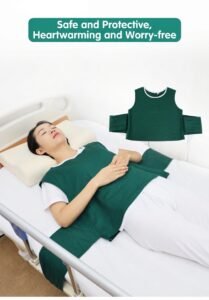
What Nursing Homes and Hospitals Should Verify Before Buying Bed Restraint Strap Belts in Bulk
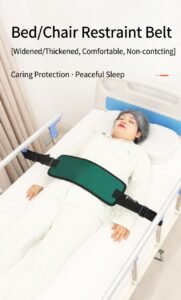
For care facility procurement teams, a bed restraint strap belt is not a generic “strap.” It is a regulated medical device with material, labeling, and training implications. The wrong bulk order creates compliance exposure and staff confusion. These are the five checks that separate a reliable supplier order from a costly mistake.
1. Confirm the Locking or Closure System Matches Your Protocol
Facilities use different restraint control philosophies. Some require key-locking buckles to prevent patient self-release. Others use quick-release buckles for faster staff response. Magnetic closures are another option in some markets. Before ordering 200 units, confirm which closure type your clinical team has approved—and that the supplier’s documentation clearly states it.
2. Verify the Sizing Range Covers Your Patient Population
One size does not fit a mixed-acuity facility. Bariatric patients need longer straps and wider pads; petite patients need shorter options that do not create excess loose webbing. Look for suppliers that publish waist ranges, total strap lengths, and pad dimensions in both metric and imperial units. If a supplier only lists “universal,” ask for the actual measurements in writing.
3. Ask for Material Specifications in Writing
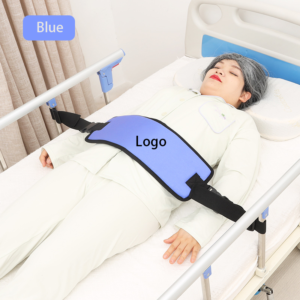
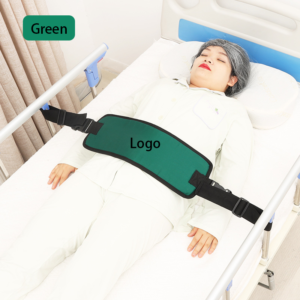
The load-bearing components should be high-strength nylon or polyester webbing. The patient-contact pad should be breathable foam or mesh laminated to a skin-friendly fabric. For facilities with latex-sensitive populations, confirm the product is not made with natural rubber latex. Vague descriptions like “premium material” are not enough for a procurement file.
4. Check the Labeling and IFU (Instructions for Use)
A compliant product ships with clear intended-use statements, contraindications, fitting instructions, and cleaning guidance. The IFU should explicitly state whether the device is for single-patient use or reusable, and what cleaning agents are compatible. If you are evaluating an Alibaba supplier, request the actual IFU document—not just a product photo.
5. Evaluate Training and Replacement-Part Support
Staff turnover in care facilities is high. A supplier that provides in-service training materials, fitting guides, or short training videos reduces your implementation burden. Also ask about replacement straps and buckle availability: if a buckle cracks in month three, can you replace the component without scrapping the entire belt?
Procurement takeaway:The lowest unit price is rarely the lowest total cost. A bed restraint strap belt that arrives without proper sizing data, clear labeling, or closure-system clarity will consume staff time and create audit risk. Source from suppliers who treat documentation as part of the product.