Support Walking Assistance Transfer Belt Types Explained: Which Configuration Actually Works for Your Situation?
Search for a support walking assistance transfer belt and you will see a confusing mix of straps, handles, buckles, and padding levels. They are not interchangeable. Each design solves a different problem. Here is how to match the belt to the job—without overbuying or regretting.
Plain Webbing Belts: The Clinic Standard That Rewards Training
A plain belt—typically 2-inch cotton or nylon webbing with a metal buckle and no handles—is what you see in hospitals and rehab gyms. The metal buckle is the most secure lock of any style. Reviewers who have been trained on the two-handed threading technique love the simplicity and the low price. But if you have not been shown how to fasten it, you will struggle. And without handles, you are gripping the strap itself, which is harder on your wrists and less secure during a sudden stumble.
Who it is for:Trained caregivers, clinicians, or anyone who has had a physical therapist demonstrate the technique. Who should skip it:Solo home caregivers who need a fast, secure grip without training.
Handled Belts: The Solo Caregiver’s Best Friend
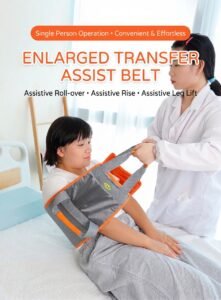
Belts with four, six, or more vertical and horizontal handles give you multiple grip points depending on the transfer angle. Walking behind the user? Grab the back handles. Assisting a sit-to-stand? Side handles. The handles also reduce the need to twist your body, which lowers your own injury risk. The trade-off is minimal: handled belts cost slightly more and have a bit more bulk. For home care, this is usually the right call.
Padded Belts: Comfort for Fragile Bodies
Padding matters when the user has thin skin, fragile ribs, or a low BMI. A wide cushioned band disperses pressure across the waist rather than concentrating it on a thin webbing line. Some padded belts also have a slip-resistant inner lining to keep the belt from riding up during movement. The downside: extra bulk under clothing and longer drying time after washing. If comfort is the deciding factor, padding wins.
Buckle Showdown: Metal vs Quick-Release Plastic
Metal buckles grip the webbing with teeth and do not release accidentally. They are the most secure option under load. But they take two hands and practice to fasten quickly. Quick-release plastic clips snap shut and pop open with one press—ideal when you are holding the user with one arm and need the belt secured or removed fast. The honest trade-off: plastic clips are less bomb-proof under a hard fall. Use plastic for guided standing and walking; use metal if you need maximum lock security and have been trained.
A Simple Decision Framework
-
Solo home caregiver, daily transfers → Handled belt with quick-release buckle.
-
User with fragile skin or ribs → Padded belt with soft inner lining.
-
Trained caregiver, budget priority → Plain webbing with metal buckle.
-
Multi-angle transfers or rehab → Six-handle belt for flexible grip positions.
-
Maximum security under load → Metal buckle, no compromise.
Bottom line:The best support walking assistance transfer belt is the one that matches your grip strength, your loved one‘s body, and the transfer you do most often. Buy for the routine, not the catalog description.