Shoulder Restraint vs Shoulder Immobilizer: Two Devices, Two Completely Different Purposes
Search for “shoulder restraint” on Google or Amazon and you will find hundreds of results for arm slings, rotator cuff supports, and post-surgery shoulder immobilizers. Those products are not restraints. Confusing the two wastes money and, in a care context, creates a false sense of safety. Here is the distinction that matters.
What a Shoulder Immobilizer Actually Does
A shoulder immobilizer is a rehabilitation device. It supports an injured arm and shoulder after surgery, dislocation, or fracture, keeping the joint in a protected position while it heals. The MSD Manual describes the standard technique: the elbow is held at 90 degrees, the arm is supported in a sling, and an elastic bandage may be wrapped around the torso to limit rotation . The goal is healing, not behavior management.
Immobilizers are designed for cooperative patients. A person wearing one can, if they choose, remove it or move in ways that compromise the repair. The device assumes the user wants to protect the injury.
What a Shoulder Restraint Actually Does
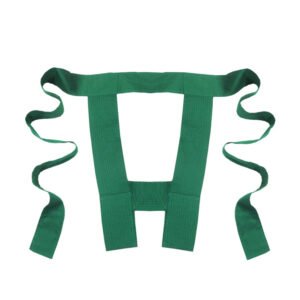
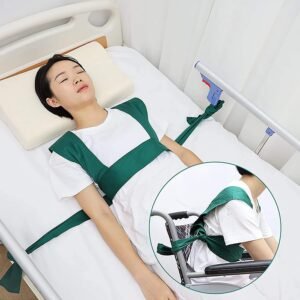
A shoulder restraint is a safety device. It limits upper-body movement to prevent a person from rising unassisted, sliding forward in a wheelchair, or otherwise putting themselves at risk of a fall. The GMDN definition for wheelchair/chair/stander occupant restraint/support describes it as “a rigid or non-rigid device… designed to be attached to a wheelchair/chair/stander and/or its occupant to stabilize the occupant’s position for prevention of slips and/or falls” .
The intended user is different. Restraints are used for people with cognitive impairment, agitation, or involuntary movement who cannot reliably judge their own safety. The device assumes the user may not cooperate—or may actively try to defeat it.
The Design Differences That Follow
Because the purposes differ, the designs diverge in predictable ways:
-
Fastener security:Immobilizers use Velcro, straps, or slings that a cooperative patient can adjust. Restraints require locking buckles, quick-release mechanisms accessible to caregivers, or magnetic closures that the occupant cannot open independently.
-
Padding and pressure distribution:Both need padding, but restraints must withstand sustained load and potential struggling. A patent filing for a shoulder restraint belt describes a buffer layer (airbag or sponge) specifically to prevent skin abrasion and strangulation during patient agitation .
-
Anchor points:Immobilizers anchor to the body. Restraints anchor to a fixed object—bed frame, wheelchair frame, or vehicle tie-down—because the goal is to limit movement relative to the furniture, not just support a limb .
The Practical Check Before You Buy
Ask one question: Is the goal to protect an injury, or to prevent a dangerous movement?
-
If the answer is “protect an injury,” buy a shoulder immobilizer or sling. Follow the MSD technique for elbow positioning and distal neurovascular checks .
-
If the answer is “prevent a fall from bed or wheelchair,” you need a restraint—and you need to confirm it is appropriate for the setting, the patient’s cognitive status, and your local regulations.
A Note on Terminology in B2B Sourcing
Alibaba listings for “shoulder support” or “shoulder brace” are almost universally immobilizers or posture correctors, not restraints . If you are sourcing for a care facility, search with terms like “occupant restraint,” “wheelchair safety belt,” or “shoulder retraction straps”—the terminology used by medical equipment suppliers rather than consumer rehab brands .
Bottom line:The word “restraint” is doing double duty in search results. Know which device you actually need before you buy. An immobilizer that does not restrain is not a bargain. A restraint used where an immobilizer was needed is an unnecessary restriction.