Why a Bed Ladder Assist With Handle Rope Becomes Essential After Surgery—and for Daily Independence
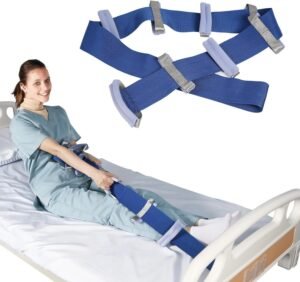
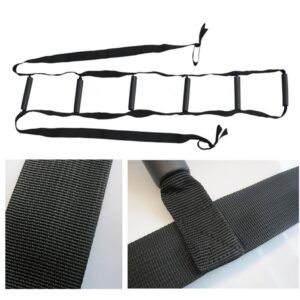
The moment you cannot sit up in bed without help is the moment you realize how much independence depends on a simple movement. A bed ladder assist with handle rope is a low-tech solution: a strap anchored to the bed frame, with padded grips the user pulls to rise to a seated position. But its value is not just mechanical. For the right user, it restores control during a period when control feels scarce.
Scenario 1: Abdominal Surgery Recovery
After abdominal surgery, the core muscles that initiate a sit-up are compromised. Pushing up with the arms alone strains the incision site. A bed ladder allows the user to pull with the arms while keeping the torso relatively stable.
One user who had emergency abdominal surgery and lived alone wrote: “This small genius product kept me from staying in the hospital even longer because it gave me independence” . Another reviewer described it as “awesome for post ovarian cyst surgery” with “sturdy” construction and handles that “have good grip” .
Scenario 2: Hip Replacement and Lower Extremity Weakness
Hip replacement protocols often restrict the deep hip flexion required for a standard sit-up. The ladder changes the mechanics: the user pulls with the upper body while the legs remain relatively straight, then swings the legs over the edge once seated.
One hip replacement patient was blunt: “Almost impossible to get in and out of bed without it” . The staged pull—hand over hand, rung by rung—matches the restricted range of motion that hip protocols demand.
Scenario 3: Shoulder and Rotator Cuff Surgery
This is a less obvious but frequently cited use case. A reviewer who had rotator cuff surgery called the ladder “invaluable for getting out of bed” . The shoulder is the primary joint used in pulling, which seems counterintuitive—but the ladder allows the user to pull with the uninjured arm while the surgical side remains protected, and the incremental rung spacing prevents sudden loads.
Scenario 4: Pregnancy and Postpartum Recovery
At 30 weeks pregnant, one reviewer wished she “would have bought this sooner to help with getting out of bed,” noting it helped “lessen my back pain and pelvic with rolling over and getting out of bed” . The ladder provides a stable grip point that compensates for the shifted center of gravity and reduced core engagement of late pregnancy.
Scenario 5: MS, Parkinson’s, and Fluctuating Strength
For people living with conditions that cause fatigue and unpredictable weakness, the ladder provides a consistent assist that does not depend on the caregiver being present. The MS user who lives alone described it as a safety net for “unexpected moments” . For Parkinson‘s users, the multiple grip points allow a slower, more controlled pull sequence that accommodates tremor and rigidity.
The Common Thread: Independence Within Reach
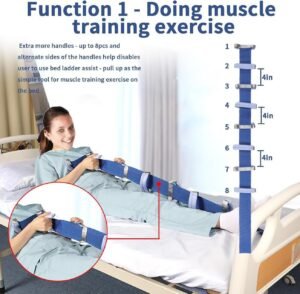
Across all these scenarios, the same three features matter: a secure buckle, a strap long enough to position the first handle at waist level, and padded grips the user can hold without pain. The Vive model’s three EVA foam handles spaced 10.5 inches apart are designed specifically for this incremental pulling motion .
A note for caregivers:The ladder does not replace supervision for users at high fall risk. Inspect the strap before each use, confirm the anchor is secure, and reassess whether the device is still appropriate as the user’s condition changes.