How to Install a 3 Handle Strap Pull Up Assist Device So It Actually Stays Put
The number one reason a bed ladder assist fails is not the product—it is the installation. A ladder anchored to a loose leg, draped without tension, or adjusted to the wrong height will shift under load. That shift is the difference between a safe sit-up and a fall. This guide covers the five-step installation process and the bed types that require extra attention.
Step 1: Identify a Fixed Anchor Point
The ladder must attach to a part of the bed that does not move when the user pulls. On a traditional bed frame, the legs at the foot of the bed are the standard anchor point . Loop the strap around the leg, thread it through the buckle, and pull tight.
What if there is no frame leg? Divan beds and platform beds with solid bases are the most common compatibility complaint. One UK reviewer returned the KkaFFe model because it “does not attach to a divan type of bed” . If your bed has no accessible leg, you have two options: choose a model with an extra-long strap that can wrap around the entire base, or create an anchor point by threading the strap under the mattress and around a slat or frame section.
Step 2: Route the Strap Over the Mattress—Not Under
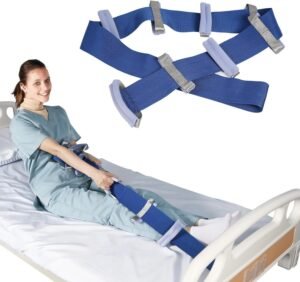
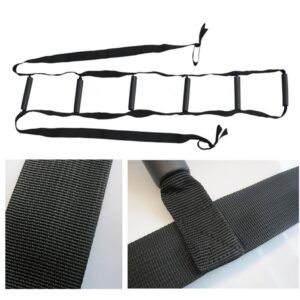
The ladder lies on top of the bed surface, with the handles positioned along the length of the mattress. The strap runs from the foot anchor point, over the mattress, toward the head of the bed. Do not route the entire strap underneath the mattress—it reduces accessibility and can create pressure points.
The slide-prevention check:Some models include a cord or loop at the handle end that can be tucked under the bottom sheet or mattress to prevent the ladder from sliding during sleep . If your model does not include this, a simple safety pin or clip can secure the top end to the sheet.
Step 3: Adjust the Length Before the User Gets In
The critical measurement: with the user lying flat on their back, the first (lowest) handle should reach their waist level. This allows them to grip without stretching or twisting, then pull hand-over-hand to the next handle as they rise.
To adjust: release the buckle, slide the strap to the correct length, and re-lock. The KkaFFe model uses two adjustable buckles at the anchor end, which allows fine-tuning of both the anchor loop and the ladder length .
Step 4: Test the Anchor Under Load—Not Just by Hand
Grab the first handle and pull firmly, simulating the angle and force the user will apply. The strap should not slide through the buckle, the anchor point should not shift, and the bed frame should not creak. If any of these happen, reposition or reinforce the anchor.
The buckle test that matters:A friction-slide buckle can feel secure under light tension but release under body weight. Pull hard—harder than the user would—and watch the buckle. If the webbing slides even a fraction, the buckle is not adequate. This is the failure mode that caused one reviewer’s clip to spring open .
Step 5: Teach the Hand-Over-Hand Technique
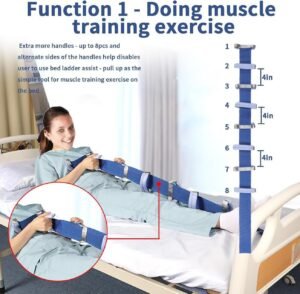
Installation is only half the job. The user needs to know how to use the ladder correctly. The safe sequence: roll slightly to one side, bend the knees, grip the first handle with an overhand grip, pull to a seated position, then move the second hand to the next handle if additional height is needed.
For users with cognitive impairment or dementia, place their hands on the correct handle and guide the first pull. The grasping reflex often remains intact even when understanding fades—one caregiver reported her mother with advanced dementia could pull herself up with minimal hand placement guidance .
Bed Type Compatibility: What Works and What Needs Modification
-
Traditional bed frame with legs:Direct anchor to foot legs. Easiest installation.
-
Divan bed:No accessible leg. Use an extra-long strap to wrap around the base, or add a dedicated anchor point.
-
Adjustable bed:Anchor to a stationary frame section. Confirm the strap does not interfere with the moving mechanism. Test all bed positions before use.
-
Queen or king bed:Standard 3-handle models may be too short. Measure first, or choose an adjustable model with a longer maximum length .
-
Travel:Choose a model with a compact strap and secure buckle that can be removed and reinstalled without tools .
Bottom line:A 3 handle bed ladder assist is only as safe as its anchor. Identify a fixed point, adjust the first handle to waist level, and test the buckle under hard pull before the user relies on it. That five-minute check prevents the most common failure.